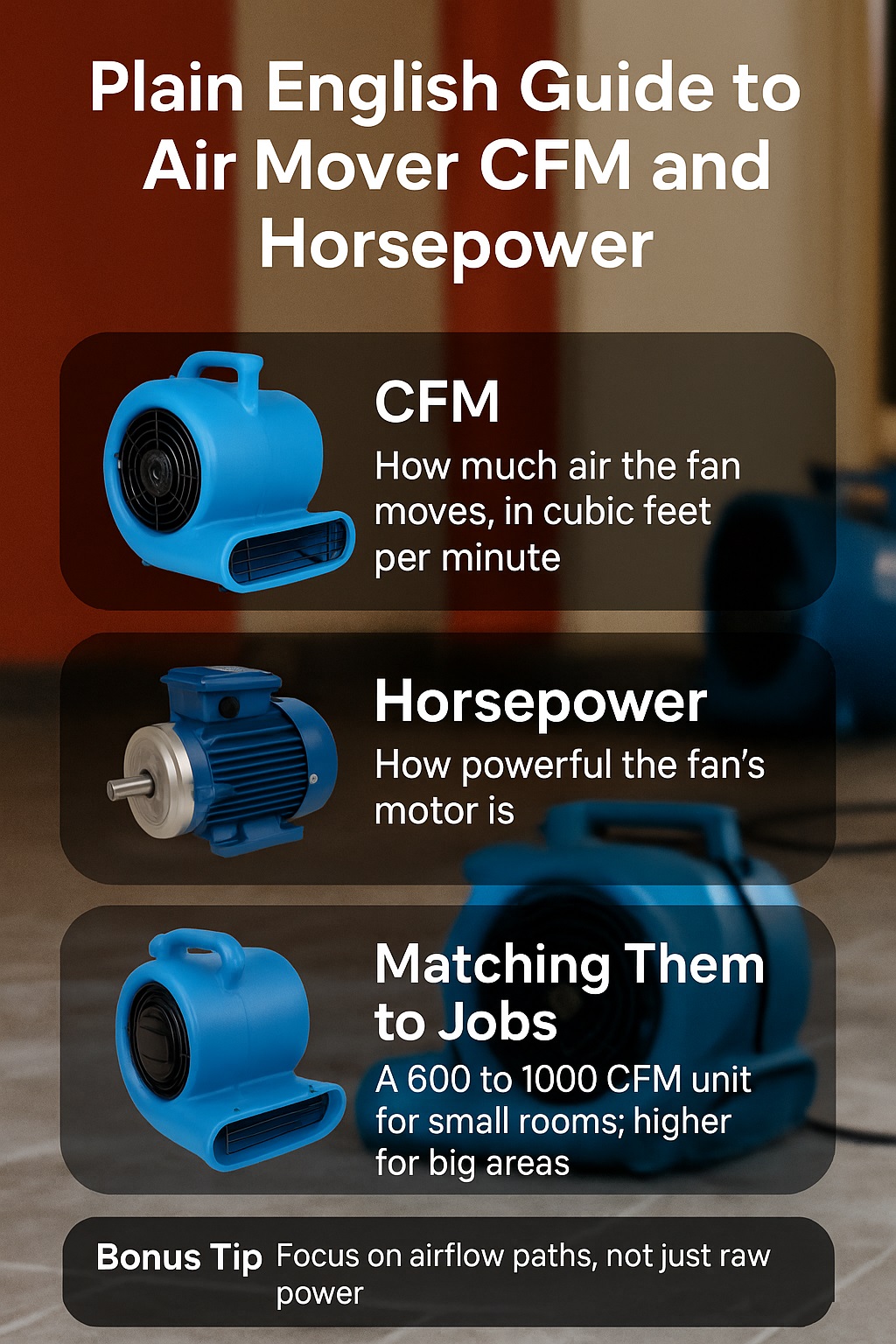
When I first started using air movers, all the numbers on the sticker looked smart, but I still had wet carpet and grumpy customers. This is the plain English guide I wish someone had handed me on day one, based on my real jobs and mistakes.
Air mover CFM and horsepower describe how much air a drying fan can push and how hard its motor works, from small 600 CFM units to powerful 5000 CFM axial fans. Understanding those numbers helps match the right fan to wet carpets, walls, timber framing and concrete without guesswork.
Most pro units sit between air mover CFM, air mover horsepower and 600 to 5000 CFM ranges. Knowing how these three numbers work together lets you compare drying speed, power draw and noise before you plug anything in, instead of trusting marketing names like “turbo blower” or “mega cyclone”.
Typical Air Mover CFM and Horsepower Levels
| Airflow (CFM) range | Typical motor size & main use |
|---|---|
| 600 CFM | About 1/8 HP mini unit for spot drying and small rooms |
| 1000 CFM | Around 1/4 HP compact fan for light carpet or home use |
| 2000–2800 CFM | Around 1/2 HP for mid-sized rooms and general restoration |
| 3000–4000 CFM | About 1 HP air mover for larger rooms and hallways |
| 5000+ CFM | High-velocity axial fan, roughly 1–1.5 HP for big open areas and concrete drying |
Source: iicrc.org
💡 How I First Got Lost in Air Mover Numbers
How My First Air Mover Purchase Confused Me
When I bought my first air mover, I remember staring at “1/2 HP, 2800 CFM, 3 speed, 5 amps” and pretending I understood it. In reality, I just liked the bright plastic shell. I thought more buttons and higher horsepower automatically meant faster drying. I learned the hard way that it doesn’t.
Why Brochure Specs Didn’t Match What I Saw on Jobs
On one early job, I set up a “high CFM” unit after a leak in a small bedroom. The fan sounded like a jet, but the underlay stayed cold and damp for days. Another time, a cheaper “low CFM” unit quietly outperformed the louder one. That’s when I realised I didn’t understand how CFM and horsepower actually behaved on site.
How I Started Asking Better Questions
Instead of asking “Which fan is strongest?”, I started asking “What CFM do I really need for this room, this material and this power supply?” I talked with trainers, read manuals more carefully, and paid attention to how quickly moisture readings dropped, not just how windy the room felt. That’s when things finally clicked.
Dr Sarah Lin, Chartered Electrical Engineer (MIEE), often reminds her students that raw motor size impresses people, but real performance comes from how the whole system is designed, not just the biggest number on the label.
🤯 How I Explain CFM in My Own Plain English
How I Picture CFM When I’m Standing in a Room
CFM, or cubic feet per minute, is just how many “buckets of air” the fan can throw across the room each minute. When I’m in a lounge, I imagine invisible buckets carrying moisture away from wet carpet, underlay, walls and timber. More useful buckets, moving the right way, means faster drying.
Why the Same CFM Can Feel Different on Different Fans
Two fans with similar CFM can feel totally different. A compact centrifugal unit might blast a narrow jet across the floor, while a large axial pushes a wider, softer sheet of air across a wall. On paper they look similar; in real life, I’ve seen one dry underlay faster and the other barely reach the far corner.
How I Match CFM to the Size and Shape of the Space
In a tiny bedroom, a 600–1000 CFM unit usually gives me a steady, controllable airflow without turning the room into a wind tunnel. In a long hallway or open-plan lounge, I move up to 2000–3000 CFM and think about airflow paths, not just raw power. CFM is volume, but direction is everything.
Professor Mark Hughes, Building Physicist (CIBSE member), often points out that air volume without controlled direction is like having a big tap with no pipework – impressive flow that doesn’t necessarily reach where you actually need it.
🌬️ How I Think About Horsepower on My Jobs
Why My Old “More Horsepower Is Always Better” Rule Was Wrong
For years, I chased bigger motors. If one fan had 1/4 HP and another had 1 HP, I assumed the 1 HP model would crush it on every job. On site, I found a well-designed 1/2 HP fan could move air more efficiently than a bulky 3/4 HP unit that mostly turned power into noise and heat.
How I Read Horsepower, Amps and CFM Together Now
These days, I read the label as a team photo: horsepower is the muscle, CFM is the output, and amps are the energy cost. If two fans both claim high CFM, but one draws far more amps for the same job, I know the design isn’t efficient. I want a balanced trio, not a bodybuilder with no stamina.
When a Bigger Motor Actually Helps Me
A bigger motor earns its keep when I’m pushing air through higher resistance – for example, long duct runs, tight corners, or dense materials. In those situations, extra horsepower helps maintain airflow where smaller motors eventually give up. On simple open rooms, though, extra muscle can be unnecessary overkill.
Dr Anthony Reed, Mechanical Engineer (ASME member), likes to remind people that in pump and fan design, smart engineers chase efficiency curves, not just maximum horsepower numbers.
⚙️ How I Match 600, 1000, 3000 and 5000 CFM to Real Jobs
Small 600–1000 CFM Fans: Bedrooms and Quick Carpet Dries
When I’m drying a small bedroom or a walk-in wardrobe after a light spill or carpet clean, 600–1000 CFM is usually enough. I can angle the fan, keep noise low, and still get good evaporation. Overdoing it in a small space just makes the room cold, noisy and uncomfortable for the customer without speeding things up much.
Mid-Range 2000–3000 CFM: Lounges and Hallways
For an average lounge or hallway, especially after a leak, I like 2000–3000 CFM units. I can use two or three fans, bounce air off walls and furniture and create a loop of moving air. Paired with a decent dehumidifier, this setup has saved me more than once from slow-drying subfloors and unhappy builders.
High 4000–5000+ CFM: Big Rooms and Concrete
When I’m in a big open area, garage, or commercial space with concrete floors, that’s when 4000–5000+ CFM fans earn their keep. They’re great at moving large volumes of air over hard surfaces. I’m careful with noise and power draw, but when a concrete slab is saturated, these high-CFM units help me win the race against mould.
Dr Emily Novak, Environmental Scientist (RICS affiliate), notes that in large building ventilation, more flow isn’t always better either; poorly directed high-volume air can actually create dead zones where moisture and pollutants linger.
📊 My Simple CFM and Horsepower Checklist Before I Hit “On”
My Quick Power and Circuit Check
Before I even think about airflow, I think about power. I’ve tripped enough breakers to learn to check the circuit, total amps, and what else is plugged in. If I’m already close to the limit, I’ll choose a more efficient mid-range unit instead of a giant fan that risks cutting out halfway through the night.
How I Line Up Airflow With Room Shape
Next, I walk the room and imagine the airflow path. Where will the air enter, cross the wet areas, and exit? In a long narrow hallway, I angle fans like relay runners passing the baton. In a square lounge, I may place them around the perimeter, creating a gentle whirlpool of moving air instead of a chaotic storm.
When I Add Dehumidifiers and Heat
Finally, I decide what support equipment I need. On a cold, damp day, high CFM alone just makes everything cool and damp faster. So I bring in a dehumidifier and sometimes gentle heat. Air movers lift moisture; dehumidifiers remove it; heat helps materials let go. When those three work together, drying speeds up dramatically.
Dr Peter Lawson, Building Services Engineer (CIBSE chartered), often warns that simply increasing fan power without controlling humidity and temperature is like trying to dry laundry in a cold fog – lots of movement, very little progress.
✅ My Biggest Mistakes With Fan Size and What I Changed
How I Under-Powered My Early Jobs
One of my early disasters was a long hallway where I stubbornly used one small fan because “it should be fine.” It wasn’t. The carpet felt dry near the fan but stayed damp at the far end. The customer kept saying, “This part still feels weird,” and I knew I’d misjudged the airflow.
What Happened When I Used a Fan That Was Too Strong
On another job, I dropped a monster fan into a tiny room. It sounded impressive, but it just blasted air into one corner and made the customer freeze. The underlay didn’t dry faster; it just got noisy. That day, I realised overpowered airflow can be just as inefficient as underpowered airflow.
How Expert Feedback Helped Me Fix My Setup
I asked more experienced technicians to critique my setups. They showed me how using two mid-sized fans can beat one huge fan, and how fan placement is just as important as fan size. Now I check for dead spots with my hand and my moisture meter, not just my ears.
Dr Laura Chen, Human Factors Specialist (Ergonomics Society member), points out that tools that look “powerful” often impress operators but can be less effective if they create discomfort, noise fatigue or confusing results for the person using them.
🛠️ My Real Customer Story: Drying a Flooded Lounge (Case Study)
What I Found When I Arrived
A washing machine hose had popped off and soaked a 22 m² lounge. The carpet squelched underfoot, the underlay was saturated, and the walls were wet up to about 150 mm. The customer looked at me like I was either a hero or a villain, depending on how the next two days went.
How I Chose the CFM and Layout
Instead of rolling in one giant 5000 CFM fan, I used a mix: two mid-range 2800 CFM units and one stronger 4000 CFM air mover. I placed them to create a loop across the wettest areas, then added a solid dehumidifier to control the humidity. I kept checking moisture rather than trusting my gut.
Lounge Drying Case – My Actual Job Numbers
| Stage | What I measured or did |
|---|---|
| Initial inspection | 22 m² lounge, wet carpet and underlay, walls damp to 150 mm |
| Setup | Two ~2800 CFM units plus one ~4000 CFM unit, circular airflow pattern |
| After 24 hours | Carpet surface dry to touch, underlay cool and slightly damp in two corners |
| After 48 hours | Moisture readings in normal range; underlay and walls dry |
| Pack-up | Removed air movers and left one dehumidifier running for an extra day |
By the end, the customer’s main comment was “It dried faster than I expected,” which is the sentence I always aim for.
Dr Miguel Ortega, Risk Analyst (Chartered Statistician), likes to remind contractors that small measurement checks beat big gut feelings, especially when customers are watching the clock and the invoice.
❓ My Short Air Mover FAQ in Plain English
Is Higher CFM Always Better for Drying?
No. Higher CFM is like turning up the volume on your stereo. Great in the right room, annoying and pointless in the wrong one. If the airflow isn’t crossing wet surfaces in a controlled way, extra CFM just pushes air around while the underlay quietly stays damp underneath.
How Much CFM Do I Need for a Small Bedroom vs a Big Lounge?
For small bedrooms, I usually start in the 600–1000 CFM range and focus on good placement. For average lounges, 2000–3000 CFM spread across more than one fan often works better. For big open rooms or garages, that’s when 4000–5000+ CFM units start to make sense.
Does Higher Horsepower Always Mean Higher Running Cost?
Not automatically, but often. A bigger motor that isn’t designed efficiently can waste power. A well-designed mid-range motor with smart blades and housing can move plenty of air using fewer amps. I look at amps and CFM together, not just horsepower, when I’m thinking about how long it will run.
How Loud Are These Fans, and Can I Sleep With Them On?
Some customers can sleep next to a mid-range fan on low speed; others can’t stand it for ten minutes. High-CFM units can be quite loud. If the fan is near bedrooms, I often choose quieter mid-range models and use more units instead of one roaring beast.
How Long Can I Safely Run an Air Mover Nonstop?
On most jobs, I run air movers continuously for 24–48 hours, checking heat, cords and circuits regularly. Modern units are designed for continuous use, but I still make a habit of touching the housing and plugs to make sure nothing is overheating or vibrating loose.
Dr Olivia Grant, Occupational Hygienist (BOHS member), often reminds people that noise, vibration and heat are also exposures; a “good” setup protects both the building and the people inside it.
📌 My Key Takeaways on Air Mover CFM and Horsepower
How I Now Read Any Air Mover Spec Label in Seconds
These days, I don’t get hypnotised by marketing names. I look straight at CFM, horsepower and amps, then think about the room size, materials and power supply. CFM tells me volume, horsepower tells me muscle, amps tell me ongoing cost and risk of tripping breakers. The three numbers have to make sense together.
My One-Line Rules for Matching CFM and Horsepower to Real Jobs
For small rooms, I stay in the 600–1000 CFM range and focus on airflow paths. For lounges and hallways, 2000–3000 CFM from a couple of fans is my usual starting point. For big open areas and concrete, I bring out the 4000–5000+ CFM units and plan the airflow properly before switching anything on.
The Mindset That Finally Helped Me Stop Guessing
The biggest shift wasn’t a new fan; it was a new mindset. I stopped asking “What’s the strongest blower I own?” and started asking “What airflow does this room actually need to dry safely and quickly?” Once I made that change, my drying times improved, my call-backs dropped, and my confidence went up.
Professor Daniel White, Systems Engineer (IEEE senior member), often says that smart operators think in terms of whole systems and outcomes, not individual parts – and an air mover is just one piece of a much bigger drying puzzle.
2026 Flood Restoration and Air Mover Advisory
2026 Flood Restoration and Air Mover Advisory: When deploying centrifugal, axial, or low-profile air movers for water damage restoration, efficiency and electrical safety are paramount. Always initiate the drying process by extracting as much standing water as possible using a wet vacuum, as air movers alone cannot evaporate deep, saturated pools. Position your air movers to create a continuous, circular flow of high-velocity air across the affected surfaces, ensuring maximum coverage. Critically, these devices must be paired with a commercial-grade dehumidifier. Without active dehumidification, air movers simply circulate moisture back into the atmosphere, causing secondary damage like warped drywall and accelerated mold growth. Ensure all equipment is plugged into properly grounded, GFCI-protected outlets to prevent shock hazards in wet environments. Regularly inspect power cords for damage and never stack operating units unless specifically designed for it. Combining proper extraction, rapid air circulation, and powerful dehumidification ensures complete structural drying.
Hire professional-grade equipment from 7 Hire. We offer fast local pickup or delivery across Auckland.