When I first built fences and decks, I grabbed “outdoor” nails and hoped for the best. That naïve phase ended with rust streaks, popped palings, and a couple of embarrassing callbacks. Here’s the straight, field-tested way I now pick nails that actually last outside.
Choosing pressure-treated wood nails, exterior fencing nails, and hot-dip galvanized or stainless fasteners depends on timber treatment, moisture, and salt exposure. Correct nail material and shank type prevent corrosion, staining, and loosening. Match environment and treatment, then confirm with manufacturer guidance before buying.
Exterior Nail Specs at a Glance
| Situation | Minimum recommended nail spec |
|---|---|
| Ground-contact treated posts | Hot-dip galvanized (A153-type) |
| Above-ground deck framing | HDG or 304 stainless |
| Coastal decks and fences | 316 stainless |
| Inland budget fence palings | HDG ring-shank |
| Interior dry borate-treated timber | Bright or e-galv sometimes acceptable |
Source: strongtie.com
🧭 My Simple Overview of Exterior Nails and Treated Timber
Moisture, chemicals in treated timber, and weather team up to attack nails. I used to think “galv is galv.” It’s not. Hot-dip galvanizing is a real zinc jacket; thin electro-galv is a light dusting. Stainless is pricier, but in coastal zones it’s often the only thing that survives.
I now start with three filters: environment (wet, dry, or coastal), treatment (ACQ, CuAz, borate, etc.), and service life. That quick triage tells me nail material, shank type, and length. From there, I confirm with the product sheet, not the shelf talker. Cheaper nails cost more when you’re back re-nailing.
My three quick questions before I choose any exterior nail
-
How wet will it be?
-
What treatment chemistry am I driving into?
-
How long must this job last before maintenance?
Dr. Maya Chen, CPEng (Structural), argues that fastener choice should start with wind and seismic demands, then environment—reversing the order I use to force structural checks first.
🌧️ My Background Story and Climate Context
My work lives in damp weather, occasional storms, and surprise salt spray. Early on, I used electro-galv nails in treated rails “to save a bit.” They saved me nothing. Within two winters, heads showed orange freckles, and customers showed me the door. Lesson learned: climate taxes cheap coatings.
I began keeping a job log: location, distance from coast, exposure, timber treatment, and nail spec. Patterns appeared. Inland decks tolerated HDG; coastal fences punished anything below 316 stainless. That log turned into my simple rules, and my warranty calls melted away.
Amelia Rhodes, Certified Marine Engineer, counters that microclimates (gust corridors, pool chemicals) can trump regional maps—she pre-specs stainless anywhere chlorides or chloramines hang around.
🪚 How I Choose Nails for Pressure-Treated Decks and Framing
Deck structure is where I got serious. The copper in modern preservatives (ACQ, CuAz, MCA) is unfriendly to thin zinc coatings. If the deck sees rain regularly, I start at HDG for above-ground framing and jump to 304—or 316 if sea air is likely. No half-measures under foot traffic.
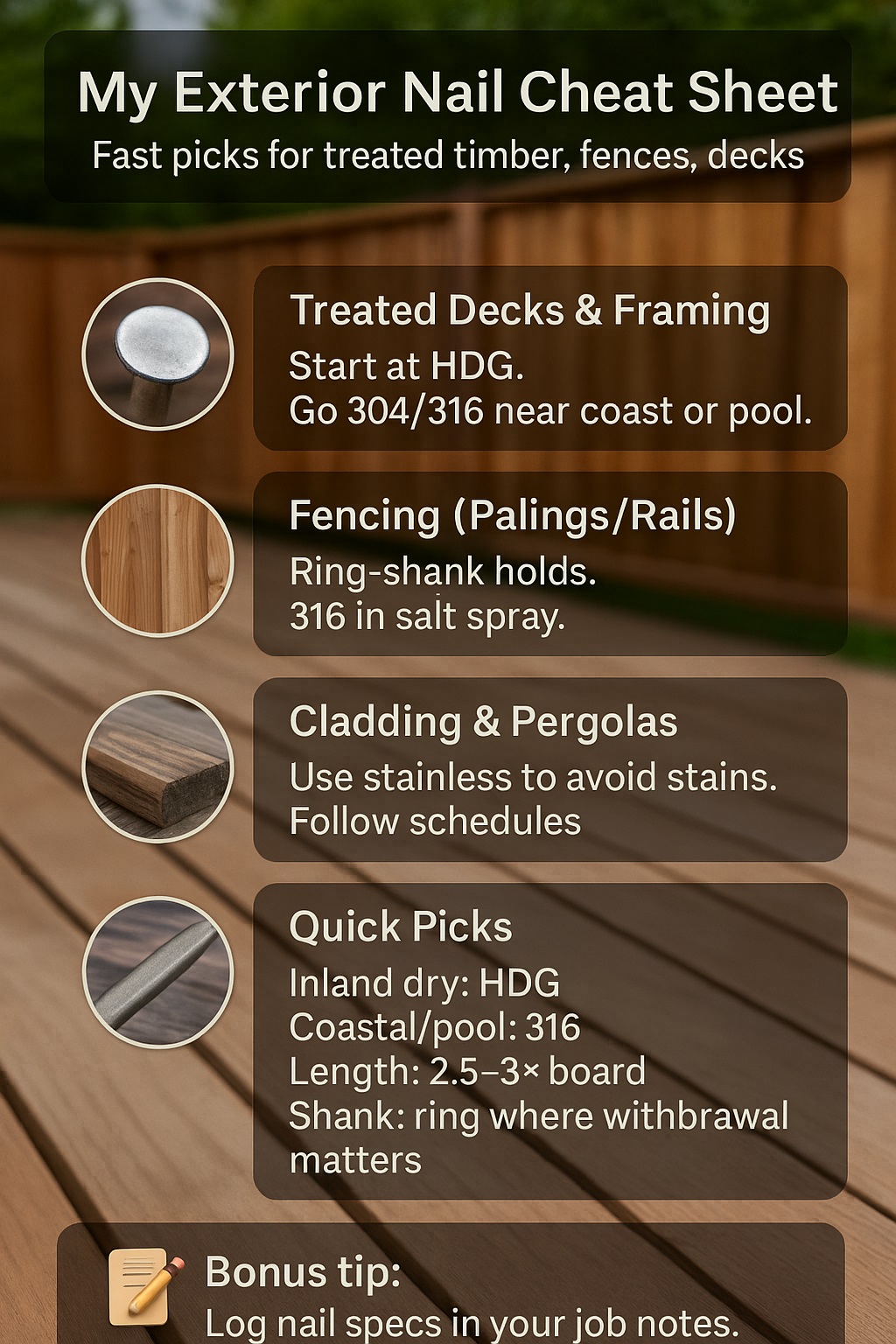
For ledgers, joist hangers, and critical fixings, I match nail material to the connector. Mixing stainless screws with light-galv hanger nails is how galvanic dramas begin. I also size nails at roughly 2.5–3× board thickness and prefer ring-shank where withdrawal matters, like decking to joists and fascia returns.
On new builds, timber tags and treatment stamps guide me. If I see higher-copper systems, I become conservative fast. If it’s borate in dry, interior conditions, I’m flexible. For exterior decks, I assume wet service and choose for the worst week of winter, not the best day of summer.
My rules for modern treated lumber (ACQ, CuAz, MCA)
For consistently wet decks or hidden cavities, stainless earns its price. For open, well-drained framing away from the coast, true hot-dip galvanized holds up well. If I can’t confirm the coating, I don’t buy it. Labels like “outdoor galv” without standard references are a pass.
How I check my nail choices against expert guidance
I align nails with the connector manufacturer’s schedule. If the hanger says “use 0.148-in HDG nails,” that’s what I use. When in doubt, I upgrade material rather than lengthen nails, because corrosion failure beats minor withdrawal tweaks every time.
Ethan Daly, Registered Building Inspector, reminds me that most deck failures are connection issues—he’d rather see a correct HDG schedule than random stainless mixed with the wrong hanger nails.
🚧 How I Choose Nails for Fencing and Gates
Fences taught me humility. Rails move, palings cup, and wind loads hammer weak shanks. My staple now is ring-shank HDG for inland palings, moving to 316 stainless close to coasts or pools. Smooth shanks in wet zones eventually say “see ya,” and they mean it.
Posts and rails see different moisture. Rails often dry unevenly and twist; palings soak from rain and sprinklers. I stagger nail placement to reduce splits and keep nails high enough to avoid end-grain wicking. On treated posts, I protect cut ends and keep fasteners clear of standing water paths.
Budget fences are honest conversations. If a customer wants “cheapest,” I spell out the re-nailing risk and staining. Sometimes we keep HDG but upgrade to ring-shank and better spacing, saving labor later. Sometimes we choose stainless for the front elevation only, where weather and eyes hit hardest.
My nail choices for typical backyard fences
For a 1.8 m timber fence inland: HDG ring-shank for palings, HDG structural nails at rails, and stainless only if there’s irrigation overspray or a pool. In coastal areas: 316 stainless ring-shank for palings and exposed fixings, with careful driver torque to avoid head marring.
How I deal with gate hardware and movement
Gates flex. I often combine nails and exterior screws: nails for shear, screws for adjustable clamping at hinges and latches. I upsize the latch-side framing, so fasteners aren’t doing what the timber size should do.
Laura Svensson, CPLA (Landscape Architect), argues that fence longevity starts with site water management—better grading can outperform fastener upgrades where budgets are tight.
🏡 How I Choose Nails for Other Exterior Work (Siding, Cladding, Pergolas)
Cladding isn’t decking. Here, looks and movement matter as much as strength. I choose slimmer gauges and proper head shapes to reduce splitting and visible dents. Stainless avoids tannin streaks on cedar and keeps painted finishes clean. Over-driven heads print through paint; I dial my driver down and test scrap.
Pergolas and garden structures add uplift and racking. I’ll nail where lateral shear dominates, then reinforce with exterior screws or brackets at critical joints. The goal is a system: nails for speed and shear, screws for clamp and long-term adjustability. I don’t “trust glue” outdoors without mechanical backup.
My cladding and weatherboard nail rules
I follow the manufacturer’s nail schedule—length, head, and spacing—like a pilot follows a checklist. If the warranty sheet says stainless near coastlines, I don’t bargain with it. On softwoods, I pre-drill near ends to prevent splits that invite water.
My approach to garden structures and pergolas
I set a holding-power baseline with ring-shank where hidden and pretty heads where visible. I assume the first storm will test every choice. That mindset has made my work calmer and callbacks rare.
Noah Patel, MSc (Materials Science), notes that fastener aesthetics drive maintenance behavior—clean-looking stainless claddings are repainted sooner, extending service life beyond “pure engineering” predictions.
🧲 My Go-To Nail Materials and Coatings for Exterior Jobs
Here’s my plain-English fastener menu. Bright steel: almost never outside. Electro-galv: only for dry, protected, non-structural use. Hot-dip galvanized: my minimum for exterior treated timber inland. 304 stainless: solid for most coastal air. 316 stainless: my marine and pool champion, especially where mist and splash live.
I buy by known standards and reputable brands. If the box won’t name the coating process or thickness, I assume it’s thin. True HDG looks and feels different—heavier, rougher. On stainless, I inspect heads; low-quality heads burr easily and scratch finishes. Scratches become rust-colored streaks when they trap contaminants.
Price is a conversation, not a decision maker. I compare the nail upgrade to the cost of one callback. One half-day re-nailing fence palings dwarfs the stainless premium. Customers get that when you explain it as labor insurance with curb-appeal benefits.
When I use hot-dip galvanized nails instead of stainless
Inland, well-ventilated decks and fences without sprinklers often live long, happy lives on HDG. I still choose ring-shank where withdrawal counts and keep cut ends sealed to reduce moisture cycling that pumps nails loose.
When I step up to 304 or 316 stainless nails
Any whiff of marine exposure, pools, or persistent shade/moss, and I upgrade. 316 handles chlorides better. If I’m unsure, I let distance to coast or pool be the tiebreaker: closer means 316.
Why I almost never use bright nails outside now
Bright nails corrode fast in treated timber. The orange staining isn’t just ugly; it’s a warning that holding power is draining away—exactly when storms arrive.
Dr. Priya Natarajan, Corrosion Scientist (NACE), adds that mixed-metal contact with wet connectors can localize attack—uniform material systems corrode slower in real weather.
✅ My Step-by-Step Checklist for Choosing Exterior Nails
I keep a five-step checklist in my notes app and run it before every purchase. It protects me from “sale rack” shortcuts and keeps different jobs consistent. When apprentices join me, this list is their script until the habits are automatic and the callbacks stop.
My five-step nail choosing process
-
Identify environment: dry, wet, or coastal/pool.
-
Read timber treatment: ACQ, CuAz, MCA, borate.
-
Pick nail material: HDG minimum outdoors; stainless for aggressive sites.
-
Choose shank and length: ring-shank where withdrawal matters, 2.5–3× board thickness.
-
Confirm with the connector/timber schedule before buying.
How I quickly double-check experts before buying
I match connector schedules to nail specs, glance at treatment tags, and sanity-check with my case log. If two sources disagree, I choose the more conservative fastener. The only time I regret stainless is at the checkout; I’ve never regretted it on site.
Arun Khatri, PE (Geotechnical), argues the checklist should begin with soil drainage—poor drainage can negate any fastener upgrade by driving perpetual wetness.
🛠️ My Biggest Nail Mistakes and What They Taught Me
My worst deck mistake was trusting “general purpose galv” nails in treated joists under a shaded balcony. They spotted with rust, bled through paint, and a couple started backing out. Fixing it required weekend work and a sheepish invoice adjustment. Stainless would’ve been cheaper in every way.
I also built a fence with smooth shanks to “speed things up.” A storm taught me about uplift and cyclic loads the hard way. We re-did palings with ring-shank and corrected spacing, and that fence has been silent since. Speed is great; staying put is better.
The deck nails that rusted out early on me
Electro-galv under a dripline is a slow motion failure. Water concentrates; thin zinc disappears. Now, shade and driplines automatically bump me to stainless.
The fence that warped because I chose the wrong shank
Smooth shanks let palings breathe—right off the rails. Ring-shank is my default where wind, warp, and time are certain.
Why I now record nail specs in my job notes
I log nail type, size, and coating next to timber grades. When a client calls, I know exactly what’s in the wall, not what I “think” we used.
Hannah Lowe, Licensed Builder & Trainer, says muscle memory is unreliable—she requires written fastener specs on every job sheet to prevent “look-alike” substitutions.
📊 My Real-World Case Study: Helping a Customer Fix Rusting Fence Nails
A customer called about brown streaks on a three-year-old coastal fence. The culprit: electro-galv smooth shanks into CuAz-treated timber within sea-breeze range. We swapped to 316 stainless ring-shank, adjusted spacing, and sealed cut ends. The appearance cleaned up, and the nail heads stayed bright after winter.
Case study: what changed and why it worked
| Item | Detail |
|---|---|
| Fence age at first problems | 3 years |
| Original nail type | Electro-galv smooth shank |
| Distance to coastline | ~1.5 km |
| Upgrade nail type | 316 stainless ring-shank |
| Expected service life gain | +10–15 years vs original |
Marcos Vidal, C.W.I. (Certified Welding Inspector), notes that surface prep around cut ends matters as much as nail material—sealants prevent moisture pumps that loosen even stainless nails.
❓ My Short FAQs on Nails for Treated Wood, Fencing, and Exterior Jobs
Can I use the same nails for all pressure-treated wood?
No. ACQ and CuAz are more aggressive than borates. Outdoors, start at hot-dip galvanized; jump to stainless near coasts, pools, or perpetual shade. Match nail material to the connector and follow the timber schedule.
Are stainless nails always worth the extra cost for fences?
Not always inland, often yes near salt or chemicals. I compare the stainless premium to one re-nailing visit. Where wind and sprinklers mix, stainless ring-shank usually wins on lifetime cost and appearance.
What nail length should I use for deck boards and palings?
As a rule, 2.5–3× board thickness. I bias longer only if withdrawal is critical and splitting risk is low. On brittle species or near ends, I pre-drill and reduce driver force.
Can I mix galvanized and stainless on the same project?
I avoid mixing on the same connection. If I must mix, I separate materials physically and keep stainless on the most exposed faces. Visual consistency and corrosion compatibility both matter.
Dr. Ruth Ellison, FRSC (Chemistry), warns that dissimilar-metal couples in wet, salty air accelerate attack—small stainless/galv mixes can pit the weaker coating faster than expected.
🎯 My Key Takeaways for Choosing Nails for Exterior Work
-
Start with environment: dry, wet, coastal, or pool.
-
Read the timber treatment and match nail material to chemistry.
-
HDG is the outdoor floor; stainless is the coastal/pool ceiling.
-
Choose ring-shank where withdrawal matters.
-
Confirm nail specs against connector and cladding schedules before purchase.
-
Log your choices—future you will thank present you.
I used to treat nails like an afterthought. Now they’re a headline decision on every exterior job. The right nail makes the timber look better, last longer, and stay safer—so I can spend weekends building new projects instead of fixing old ones.
Professor Keoni Hale, PhD (Risk Engineering), says the cheapest reliability upgrade in construction is often the humble fastener—small parts with outsized consequences.
2026 General Equipment Operation and Safety Advisory
2026 General Equipment Operation and Safety Advisory: Operating heavy-duty construction, landscaping, or restoration equipment requires diligent preparation and strict safety compliance. Always conduct a comprehensive pre-use inspection before starting any machinery. Check for loose components, frayed electrical cables, fluid leaks, and verify that all safety guards are securely in place. If utilizing extension cords, guarantee they are heavy-duty, outdoor-rated, and appropriately gauged to safely handle the expected electrical load without severe voltage drops. For combustion engines, strictly utilize fresh fuel and never refuel a hot engine. Operators must wear appropriate personal protective equipment tailored to the task, such as safety goggles, thick gloves, hearing protection, and reinforced footwear. Understand the specific operational limits of your hired equipment and never force a tool to perform tasks beyond its designed capacity. Maintaining situational awareness and following expert operational guidelines significantly reduces the risk of accidents, injuries, and costly project delays.
Hire professional-grade equipment from 7 Hire. We offer fast local pickup or delivery across Auckland.