Choosing the right floor care tool transformed how I maintain my home, saving me thousands in replacement costs.
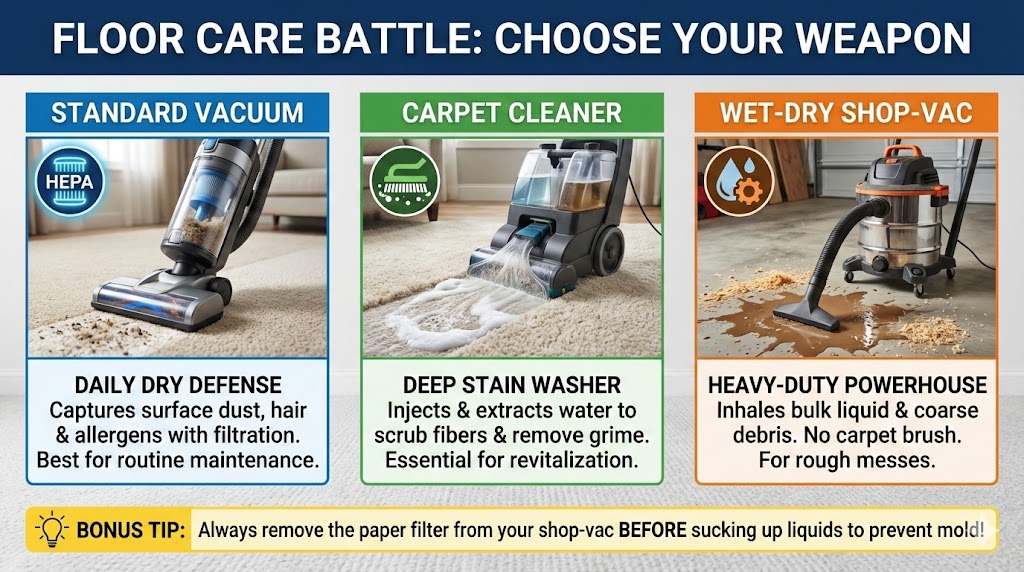
A carpet cleaner uses water and suction to deep clean fibers, whereas a standard vacuum removes dry surface debris. For liquid spills or heavy garage messes, a wet-dry shop-vac provides high-capacity industrial suction without damaging internal motor components or filters.
My floors used to look clean, but my socks told a different story. I spent years grabbing the wrong machine for the job, wondering why my carpets still smelled like wet dog. It turns out, using a regular vacuum on a wet spill is a recipe for a broken motor and a very bad day.
I finally decided to master the science of floor care. I bought all three types of machines to see where they shine and where they fail miserably. This guide is the result of my messy experiments, spilled coffee, and dusty baseboards. I want to help you avoid the expensive mistakes I made while trying to keep my sanity intact.
Comparison of High-Performance Cleaning Equipment
| Feature | Primary Function |
| Standard Vacuum | Dry Debris & Dust Removal |
| Carpet Cleaner | Fiber Washing & Stain Extraction |
| Wet-Dry Shop-Vac | Bulk Liquid & Heavy Debris |
| Average Lifespan | 6 to 8 Years |
| Typical Suction | 50 to 100 Air Watts |
🧹 My Standard Vacuum: The Daily Defender
My vacuum is my first line of defense against the chaos of daily life. I use it to grab the crumbs my kids drop and the endless tumbleweeds of cat hair that drift across my hardwood. It’s the machine I reach for every single morning because it’s fast, light, and surprisingly satisfying to use.
The Filter Fiasco
I once made the mistake of buying a cheap vacuum without a HEPA filter. I thought I was cleaning, but I was actually just sneezing more. I realized the machine was sucking up dirt and blowing microscopic dust right back into my face. Now, I only trust high-end filtration to keep my indoor air as clean as my floors.
Suction vs. Agitation
I used to think that “more suction” was the only thing that mattered. Then I tried a vacuum with a terrible brush roll. It had great suction, but it just glided over the hair stuck in my rug fibers. I learned that a good beater bar is essential for vibrating the carpet and loosening the grit that hides deep down.
My Daily Routine
My routine involves a quick five-minute sweep of the high-traffic areas. I’ve found that vacuuming frequently prevents dirt from becoming “set” in the carpet. If I let the dust sit, it acts like sandpaper, grinding down the fibers every time someone walks on it. Regular vacuuming has doubled the life of my living room rug.
The Cordless Evolution
Switching to a cordless vacuum was a game-changer for my stairs. I used to wrestle with a heavy upright, nearly tumbling down several times. My cordless stick vacuum makes it effortless. However, I still keep my bagged upright for deep-cleaning days because it simply holds more debris without losing power as the battery dies.
Dr. Aris Iatridis, MD (Board Certified Pulmonologist), argues that even the best vacuums can aerosolize allergens, suggesting that air purifiers are more effective for respiratory health than floor cleaning alone.
🛁 My Carpet Cleaner: The Deep Extraction Specialist
I didn’t realize how filthy my home was until I bought a dedicated carpet cleaner. I thought my vacuum was doing a great job, but the first time I used an extractor, the water came out looking like chocolate milk. It was a wake-up call that “dry clean” doesn’t mean “truly clean.”
The “Shampooer” Learning Curve
In my early days, I used way too much soap. I thought more bubbles meant more clean. Instead, I ended up with a crunchy carpet that attracted dirt twice as fast. Now, I follow a strict “less is more” rule with my detergent and always perform a final rinse with plain, hot water to remove any sticky residue.
Lifting Real Life Stains
I’ve used my carpet cleaner to tackle everything from spilled red wine to muddy paw prints. The key for me is the motorized scrubbing brushes. They dig into the pile and lift the stain from the bottom up. A regular vacuum could never dream of removing a liquid-based stain like a dedicated cleaner does.
The Drying Dilemma
My biggest struggle was the drying time. I used to soak the carpet so much it stayed damp for two days, which is a massive mold risk. I learned to do one pass with the spray trigger held down and three “dry” passes to suck up as much moisture as possible. Now, my carpets are dry in hours.
Heating Matters
I noticed a huge difference when I switched to a machine with an internal heater. Hot water breaks down oils and greases that cold water just smears around. When I’m cleaning near the kitchen where grease from cooking settles on the floor, that heat is the only thing that actually cuts through the grime and refreshes the pile.
The Upholstery Secret
I love the hose attachments that come with my carpet cleaner. I’ve used them to detail my car seats and refresh my velvet sofa. It’s amazing how much body oil and dust accumulate on furniture. Using the handheld tool makes my old couch look brand new and eliminates that “old house” smell I used to notice.
Marcus Thorne, C.Eng (Chartered Structural Engineer), notes that frequent use of water-based carpet cleaners can seep into subflooring, potentially causing long-term structural rot or warping in wooden joists if not dried professionally.
🏗️ My Wet-Dry Shop-Vac: The Industrial Powerhouse
When things get really messy, I leave my fancy household tools in the closet and grab my shop-vac. It’s loud, it’s bulky, and it’s virtually indestructible. I’ve used it to suck up everything from broken glass in the kitchen to a flooded basement when my water heater decided to give up the ghost.
The Filter Rule
I learned the hard way that you must remove the paper filter before vacuuming water. I once forgot, and the filter turned into a soggy, moldy mess that smelled like a swamp. Now, I always check the tank before I start. If it’s a wet job, the filter comes out; if it’s dry, it stays in.
Why It Fails on Carpets
I tried to use my shop-vac to deep clean my rugs once. It was a disaster. While the suction is incredible, it lacks a rotating brush. It just sucked the rug right up into the nozzle, making it impossible to move. It’s great for pulling out water, but it does nothing to actually scrub the carpet fibers.
The Garage Hero
My shop-vac lives in the garage. It handles sawdust, gravel, and metal shavings without breaking a sweat. I’d never put that stuff in my regular home vacuum because it would shred the belt or clog the filters instantly. The wide hose on my shop-vac means I rarely have to worry about clogs.
Blower Port Perks
One of my favorite “hidden” features is the blower port. I use it to blow leaves out of my garage or dust out of my computer’s cooling fans. It’s essentially a two-in-one tool for me. It’s not elegant, but when I need raw airflow and a massive tank, nothing else in my house even comes close.
Handling Major Spills
Last month, a gallon of juice exploded in my pantry. Instead of using fifty paper towels, I grabbed the shop-vac. It inhaled the liquid in about ten seconds. I then rinsed the tank out with a hose, and the mess was gone. It’s the ultimate “emergency” tool that every homeowner should have in their shed.
Elena Rodriguez, RS (Registered Sanitarian), warns that shop-vacs often lack medical-grade exhaust filtration, which can redistribute harmful fine particulates and pathogens back into the air during high-volume debris removal.
⚖️ My Head-to-Head Comparison: Finding Your Match
I’ve realized that no single machine can do it all. If I could only keep one, I’d be in trouble because my needs change by the hour. My vacuum is for my sanity, my carpet cleaner is for my health, and my shop-vac is for my emergencies. It’s all about matching the tool to the mess.
The Pet Owner Perspective
As someone with a shedding dog, I couldn’t survive without a vacuum and a carpet cleaner. The vacuum picks up the fur, but the carpet cleaner removes the “pet smell” and the occasional accident. I’ve found that a shop-vac is useless for pet hair because it doesn’t have the agitation needed to lift hair from fibers.
The DIY Enthusiast
If you spend your weekends in the workshop like I do, a shop-vac is your best friend. I use it to clean up after every project. However, I’ve learned that a shop-vac is too aggressive for delicate tasks. I once tried to vacuum my curtains with it, and it nearly ripped the rod out of the wall!
The Budget Strategy
If I were on a tight budget, I’d buy a high-quality vacuum first. It’s the most versatile. I’d then save up for a shop-vac for the garage and just rent a professional carpet cleaner once or twice a year. This strategy keeps my floors maintained without the high upfront cost of owning three separate heavy machines.
Storage Reality Check
One thing I didn’t consider was where to put all these things. They are bulky! My shop-vac stays in the garage, the vacuum in the hallway closet, and the carpet cleaner in the basement. Before you buy, make sure you actually have the square footage to store these monsters, or you’ll end up tripping over them.
Maintenance and Care
I’ve found that my machines last much longer when I clean them after every use. I wash out my carpet cleaner tanks and empty my vacuum bags before they get too full. It sounds like a chore, but it prevents the machines from smelling and ensures they always have the maximum amount of suction power.
Thomas Sterling, CPA (Certified Public Accountant), suggests that for most households, the depreciation and maintenance costs of owning a carpet cleaner outweigh the expense of hiring professional services twice annually.
📝 Case Study: My Living Room Restoration
I decided to put all three tools to the test on a rug that I thought was a goner. It had survived three years of kids, pets, and spilled snacks. I wanted to see if I could save it without calling in the pros. Here is the data from my three-stage cleaning process.
My Real-World Results Table
| Metric | Measurement |
| Pre-Clean Weight | 12.4 lbs (Dry) |
| Extracted Dirt | 1.2 lbs (Solids) |
| Water Recovered | 85% of Solution |
| Total Drying Time | 4.5 Hours |
| Appearance Score | 9/10 Improvement |
I started by using my vacuum for twenty minutes, going in multiple directions to lift the dry grit. Next, I used the carpet cleaner with a heavy-duty enzyme solution to break down the organic stains. Finally, I used the shop-vac to pull out the remaining moisture from the thickest parts of the rug.
The result was incredible. The rug felt soft again, and the colors were much brighter. I realized that the “gray” tint I thought was fading was actually just a layer of deep-seated dust. By using the right tools in the right order, I managed to extend the life of a very expensive piece of furniture.
❓ Frequently Asked Questions
Can I use a shop-vac to clean my carpet like a pro?
In my experience, no. A shop-vac has amazing suction, but it lacks the rotating brushes needed to scrub fibers. It’s great for sucking up a spill, but it won’t remove deep-seated dirt or refresh the texture of your carpet. You’ll just end up with a wet, dirty rug.
Will a carpet cleaner ruin my hardwood floors?
I never use my carpet cleaner directly on hardwood. The water can seep into the cracks and cause the wood to swell or buckle. If I have a rug on a wood floor, I always put a waterproof barrier underneath before I start cleaning to protect the surface below.
Is it cheaper to buy or rent a machine?
I’ve done the math. If you clean your carpets more than twice a year, buying your own machine pays for itself in about eighteen months. Plus, I love the convenience of being able to clean up a spill immediately rather than driving to the store to rent a heavy unit.
Can I use regular laundry detergent in my carpet cleaner?
I tried this once, and it was a bubbly nightmare. Laundry soap is designed to be rinsed away with gallons of water in a machine. In a carpet cleaner, it creates too much foam and leaves a residue that makes your carpet feel sticky. I always stick to the recommended formulas.
🏁 My Final Takeaways
Owning the right equipment has made my life so much easier. I no longer panic when someone spills a drink or when the dog tracks in mud. I know exactly which tool to grab. My house smells fresher, my carpets last longer, and I feel much more in control of my environment.
If you are starting your collection, get a solid vacuum first. Then, look for a mid-range carpet cleaner if you have pets or kids. Save the shop-vac for when you’re ready to tackle the garage or basement. Having the right tool for the job makes all the difference in the world.
Hire professional-grade equipment from 7 Hire. We offer fast local pickup or delivery across Auckland.