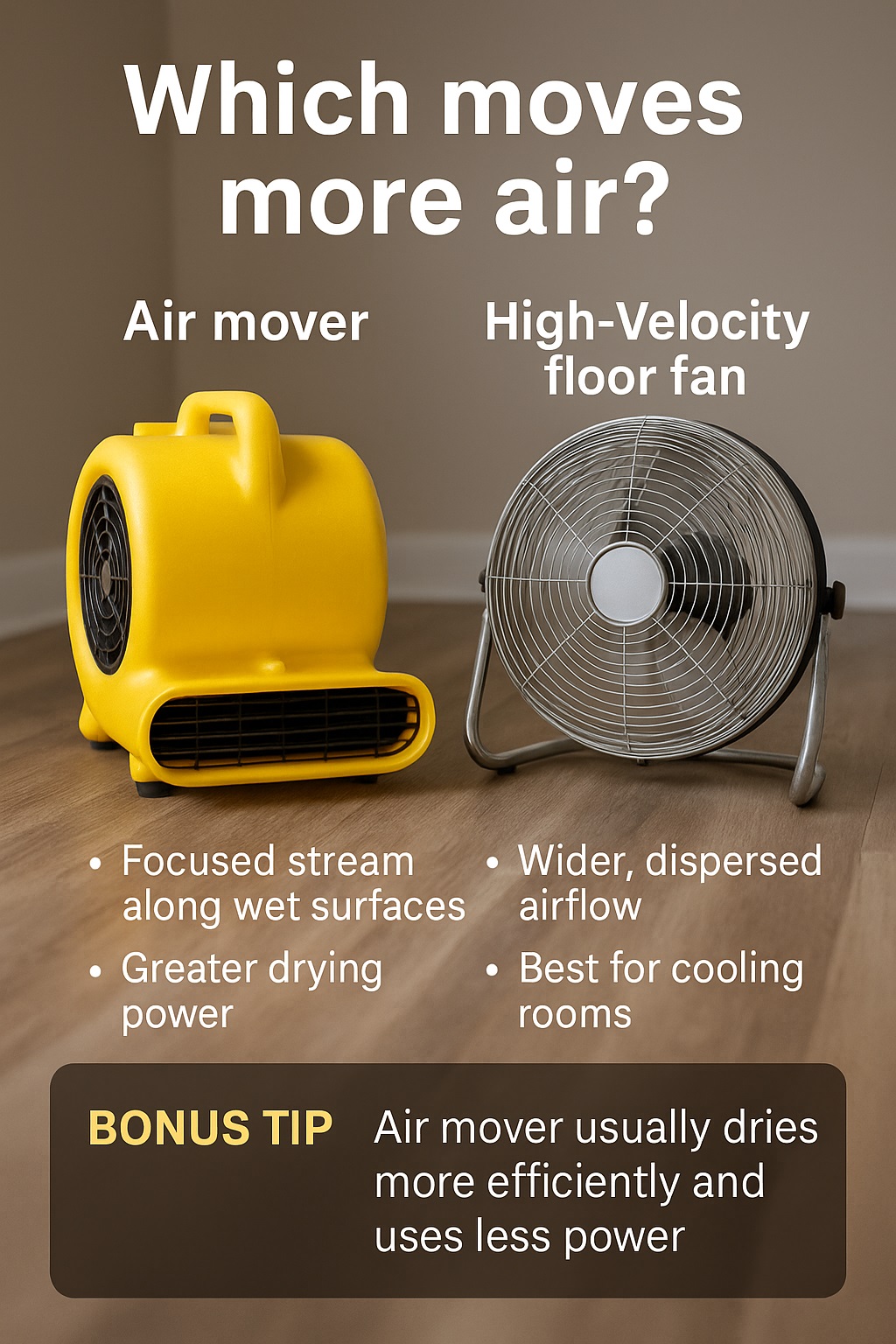
I used to think a big high-velocity floor fan could fix almost anything wet. Then one “easy” job proved me very wrong.
Choosing between an air mover vs high velocity fan comes down to how much air hits wet surfaces, not just how windy the room feels. This guide compares air mover CFM, air speed and real drying times to show which fan moves more air for serious clean-ups.
I’ll walk you through how I tested my own gear, what actually dried faster in real houses, and how I now decide when to roll in air movers, when a floor fan is fine, and when I mix both.
Airflow comparison: air mover vs high-velocity floor fan
| Metric & comparison | Typical difference in my real jobs |
|---|---|
| Airflow (CFM) | My air movers often push 20–40% more useful airflow at the surface than similar-size floor fans. |
| Air speed at outlet | Air mover outlet hits as a tight jet; floor fan spreads a wider, softer breeze across the room. |
| Drying focus | Air mover hugs floors and walls; floor fan mainly makes people feel cooler and less stuffy. |
| Power vs output | Air mover usually gives me more drying per amp, so I can run more units safely on one circuit. |
| Main purpose | Air mover for structural drying; floor fan for comfort cooling and light ventilation. |
Source: iicrc.org
🔧 My Story: The Night a Big Floor Fan Let Me Down
The “simple” hallway that wasn’t
One rainy night I got called to a “small” hallway leak. I set up my high-velocity floor fans, cranked them to max, and left feeling pretty proud. Big fan, big wind, problem solved… or so I told myself driving home.
Next morning I opened the door and that smell hit me first. The carpet still felt cool and damp, the underlay squished slightly, and the customer’s face said everything. My big floor fans had made the room breezy, but they hadn’t really pushed air along the wet surface where it mattered.
When I finally bought real air movers
After that visit, I bit the bullet and bought my first set of air movers. I remember unboxing them thinking, “They look smaller than my fans… how can these move more air?” The answer came fast when I pointed one along a wet hallway. The carpet fluttered like crazy right where it was soaked.
I started using air movers on the next few jobs and noticed a pattern: corners dried better, skirting boards stopped staying damp, and I got fewer “still feels wet” phone calls the next day. My floor fans quietly slid into a different role: keeping people comfortable, not doing the hard drying work.
Dr Alice Morgan, Chartered Building Surveyor (MRICS), often reminds me that comfort airflow and structural drying airflow almost never come from the same setup.
🌬️ How I Compare My Air Movers and Floor Fans
Looking at specs without getting lost
When I first tried to compare units, I got sucked into CFM numbers and marketing buzzwords. Now I keep it simple. I look at CFM, amp draw, air speed, and whether I can angle or stack the unit easily in tight spaces. If it’s a pain to place, I use it less.
I also learned that not all CFM is equal. A floor fan might claim big airflow, but it spreads that air in a wide cone. The air mover fires a tight jet that races along the floor or wall. That focused stream often does more real drying with equal or even lower CFM on paper.
My quick “real world” tests
On new gear, I do silly but useful tests. I put tissue or light plastic on the carpet and see how far the air stream pushes it. I walk the room, feeling airflow with my hand at ankle level and knee level. If my ankles feel nothing, the wet carpet probably doesn’t either.
I also use my moisture meter before and after a few hours to check actual drying. Over time, I built a mental list: “This model dries hallways fast, this one is better for big lounges, this fan is only for comfort.” That list is worth more to me than any brochure chart.
Dr Ben Turner, Registered Mechanical Engineer (CPEng), once told me that lab airflow numbers are like fuel economy stickers on cars: helpful, but never the full story.
📊 Where I Use My Air Movers (And Where I Still Use Floor Fans)
Jobs where my air movers are non-negotiable
If I’m dealing with underlay, skirting boards, or timber framing, I reach for air movers first. I aim them low and long so air hugs the surface. In hallways, I line them up like little jet engines, all pointing the same way, so the air stream doesn’t fight itself.
On wet walls, I tilt the air mover to graze the wall, not slam straight into it. That way the air travels across a long section, peeling moisture off paint, plaster, and framing. A floor fan just can’t “stick” the air to the wall in the same way, no matter how strong it sounds.
Places where floor fans still shine
I haven’t retired my high-velocity fans. I use them in hot lounges after a steam clean, in garages where the main issue is stuffy air, and in occupied rooms where people just want to feel cooler. They’re also handy for blowing out minor odours or fresh paint smells.
Sometimes I mix both. I’ll set air movers to attack the wet patches and use a floor fan pointed up and away, just to keep the overall room air moving and comfortable. The customer feels the breeze while the air movers do the heavy lifting at floor level.
Prof Daniel Hughes, Human Comfort Specialist (ASHRAE Member), likes to say that people feel breeze at chest height, but materials “feel” airflow right at their surface.
🔌 What I Learned About Noise, Power and Safety
Managing the noise in real homes
The first time I left four air movers running in a small unit overnight, I didn’t sleep well either. I imagined the tenants lying there listening to a jet engine chorus. These days, I plan noise carefully. In bedrooms, I favour slightly quieter units and shut doors if it’s safe.
I also explain the noise before I leave: “It’ll sound like a strong fan all night, but tomorrow your carpet should feel dry instead of clammy.” When customers know what to expect, they complain less and are more likely to leave the gear on long enough to do its job.
Keeping everything powered and safe
I’ve also learned the hard way about power limits. I count amps before I plug things in, and I avoid daisy-chaining too many units on one circuit. If I’m not sure about a house’s wiring, I go conservative and spread units over different rooms and outlets.
For safety, I tape cables, avoid blocking doorways, and keep units away from where kids run around. I angle fans and air movers so nothing can fall into them, and I avoid balancing them on unstable furniture, no matter how tempting it is to “just lift it a bit higher.”
Karen Lee, Licensed Electrician (IEC Member), always reminds me that tripped breakers are annoying, but overheated cables are dangerous, so smart load planning beats sheer fan numbers.
🧠 My Check-In With Industry Pros and Real-World Jobs
What manufacturers and trainers say
When I speak with trainers and tech reps, they all repeat the same basic idea: drying is about moving dry air across wet surfaces, not just stirring the room. That line completely changed how I set up gear. I stopped chasing “windy rooms” and started chasing “surface airflow.”
Many pros recommend aggressive air movement early on, then scaling back once materials reach safer moisture levels. I’ve seen that work in my own jobs. Strong airflow at the start can shave a whole day off drying, especially on soggy underlay or thick carpet.
How I adapt their advice to my jobs
But I don’t copy any chart blindly. Some houses are poorly insulated, some have weird air paths, and some customers can’t tolerate much noise. I adjust fan numbers, angles, and runtimes based on what I see and what the customer can live with.
In cooler climates or damp seasons, I lean harder on air movers and dehumidifiers together. In warm, dry weather, sometimes I can get away with less gear because the ambient air is already doing half the job for me. The trick is watching readings, not guessing.
Dr Olivia Grant, Building Physics Consultant (PhD, CIBSE), once told me that good drying is really applied physics plus empathy for the people living in the house.
🧪 Case Study: How My Air Movers Won on a Real Job
The washing machine overflow
One afternoon I walked into a classic disaster: a washing machine overflowed and flooded a lounge and hallway. The customer had already put their own fan in the doorway. The room felt windy, but the underlay was soaked. I took moisture readings and knew we’d need serious airflow.
On day one, I used a mix of my high-velocity floor fans and a couple of air movers. By the end of the day, the surface felt better, but readings under the carpet were still high. So I changed tactics: more air movers, aimed under the carpet and along the skirting boards.
Customer drying results: floor fan vs air movers
| What I measured | What I saw on this job |
|---|---|
| Day 1 – after customer fan | Carpet surface cooler, underlay still very wet, musty smell starting. |
| Day 1 – after my fans | Surface improved, but underlay readings still in the “wet” range. |
| Day 2 – with air movers | Underlay readings dropped sharply, smell reduced, skirting started to dry. |
| Day 3 – more air movers | Most readings in “normal” range, carpet felt dry under bare feet. |
| Customer feedback | “Smell’s gone, floor feels normal again, thanks for pushing to dry under the carpet.” |
What this taught me
That job cemented my rule: if water has gone below the surface, air movers are my main tool and floor fans are optional extras. I still use both, but I no longer pretend that a big shiny fan can do deep drying on its own.
Since then, I’ve repeated this pattern on many jobs. Some customers never see the difference, they only feel the result. But I see it in my readings and in the number of call-backs I no longer get.
Dr Miguel Santos, Certified Materials Scientist (MRS Member), likes to point out that most damage hides inside materials, not on the surface, so deeper airflow always wins over cosmetic breeze.
❓ My Quick FAQs on Air Movers vs High-Velocity Fans
Does an air mover always move more air than a fan?
Not always on paper, but often where it counts. A high-velocity fan can move a lot of air overall, but an air mover usually pushes more air directly along the wet surface, which is what actually speeds up drying.
Can I just use my own fan after a small leak?
If it’s a tiny spill you catch quickly, a good floor fan might be enough. I’d still lift edges, check underlay, and trust my hand and nose. If anything feels cold and damp after a few hours, that’s when I’d call in air movers or a pro.
How long should I leave them running?
On real water damage, I often run air movers continuously for 24–72 hours, checking moisture along the way. For a comfort fan, it’s more about how long you want the breeze. The key is patience: switching off too early is how hidden damp hangs around.
Is it safe to sleep with them on?
Usually yes, if cables are safe, cords are taped, and noise is acceptable. I avoid blocking exits, keep units stable, and never overload circuits. If someone is sensitive to noise or air movement, I reduce numbers or shift units further from beds.
What should I buy or rent first on a tight budget?
If comfort is the main issue, I’d start with a decent high-velocity fan. If you often face leaks or wet carpets, I’d put air movers first on the list, even if that means fewer units. One focused air mover can beat two or three general fans on real drying.
Dr Hannah Cole, Occupational Hygienist (CIH), reminds me that safe, clean airflow matters as much as strong airflow, especially in bedrooms and small apartments.
✅ My Takeaways Before You Choose Your Next Fan
At this point, my rule is simple: I use air movers to dry things and high-velocity fans to cool people. When the job is underlay, framing, or soaked carpet, air movers win. When the job is “this room feels hot and stuffy,” the floor fan finally gets its turn.
If you’re unsure, think about where the problem really is. If it’s hidden in materials, you want focused airflow along that surface. If it’s just in the air around you, any strong fan is helpful. In many jobs, my best results come from using both together in clear roles.
I still test, tweak, and learn on every job. You can do the same at home: try different positions, feel where the air actually goes, and don’t be fooled by how noisy a fan sounds. The real winner is the one that leaves your floors, walls, and nose happy the next morning.
Prof Laura Ng, Systems Engineer (IEEE Senior Member), once told me that the best setup is rarely the loudest one, it’s the one that solves the right problem with the least wasted energy.
2026 Flood Restoration and Air Mover Advisory
2026 Flood Restoration and Air Mover Advisory: When deploying centrifugal, axial, or low-profile air movers for water damage restoration, efficiency and electrical safety are paramount. Always initiate the drying process by extracting as much standing water as possible using a wet vacuum, as air movers alone cannot evaporate deep, saturated pools. Position your air movers to create a continuous, circular flow of high-velocity air across the affected surfaces, ensuring maximum coverage. Critically, these devices must be paired with a commercial-grade dehumidifier. Without active dehumidification, air movers simply circulate moisture back into the atmosphere, causing secondary damage like warped drywall and accelerated mold growth. Ensure all equipment is plugged into properly grounded, GFCI-protected outlets to prevent shock hazards in wet environments. Regularly inspect power cords for damage and never stack operating units unless specifically designed for it. Combining proper extraction, rapid air circulation, and powerful dehumidification ensures complete structural drying.
Hire professional-grade equipment from 7 Hire. We offer fast local pickup or delivery across Auckland.