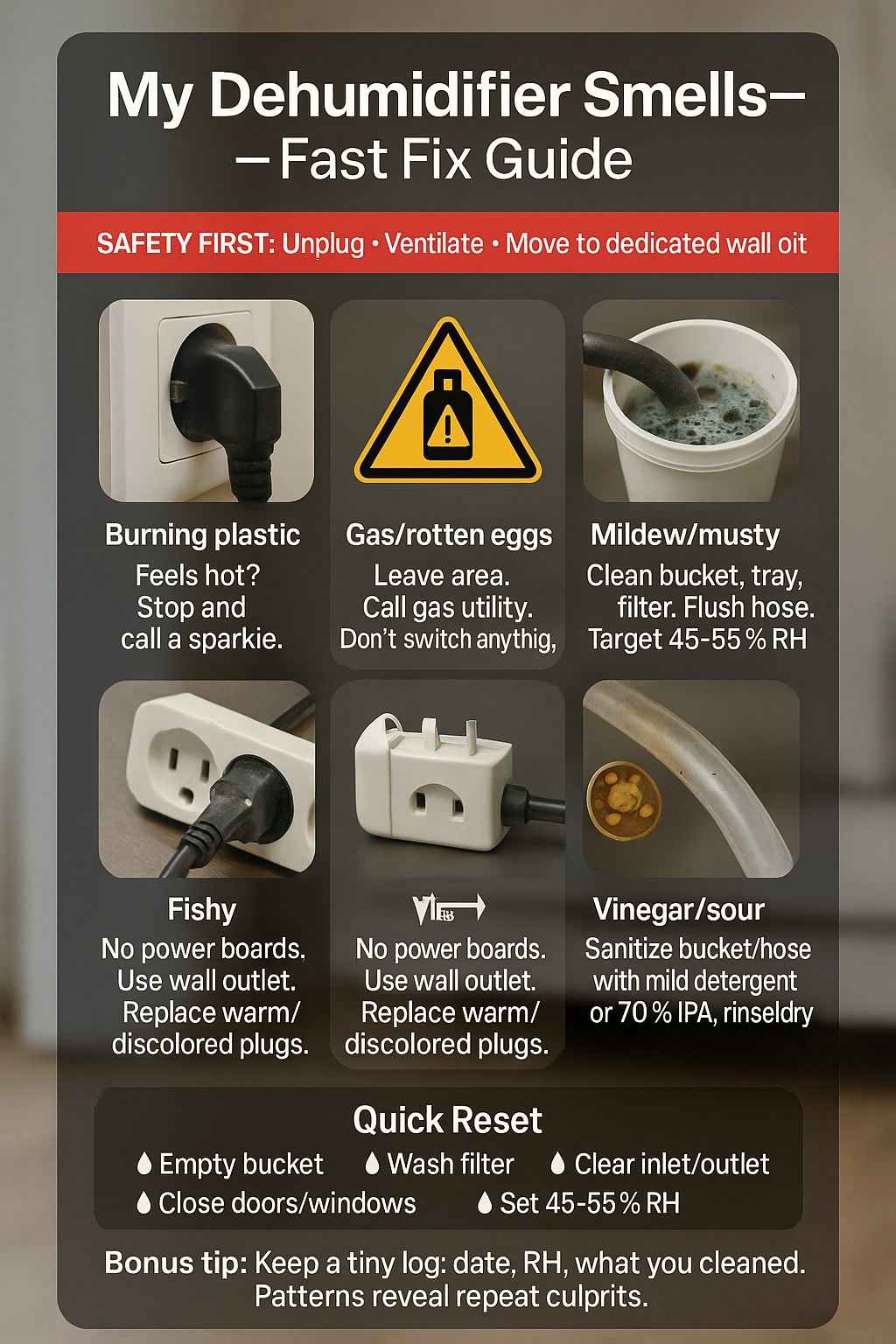
My Dehumidifier Smells — How I Find and Fix Weird Odors Fast
My dehumidifier once filled my hallway with a nasty smell, so I built a quick, safe system to track it down and fix it without drama.
Dehumidifier Odor Facts (Phone-Friendly)
| What | Data |
|---|---|
| Indoor humidity goal | 30–50% RH |
| Mold risk rises above | 60% RH |
| Mold can start on wet surfaces | 24–48 hours |
| Key prevention | Fix moisture + ventilate spaces |
| Basic cleanup | Detergent + dry completely |
Source: epa.gov
🧠 Why My Nose Matters (Safety First, Always)
I run drying gear often, so I trust my nose. If I smell burning or “gas,” I stop, unplug, ventilate, and step away. I never keep a hot plug running “just to test.” I check the outlet with my hand (carefully), look for browning, and feel the cord jacket for stiffness or cracks before I even think about restarting.
I also log room humidity, temperature, and what I changed (filter wash, hose flush). That tiny log helps me spot patterns, like odors returning when I forget to clean the bucket after a weekend job. Small habit, big payoff. If anything seems unsafe—sparks, buzzing, or melted plastic—I call a pro immediately and don’t argue with reality.
*“Your nose is an early-warning sensor,” notes Hannah Lee, CPEng (Electrical)—if heat or chemical odor appears, stop before investigating.
🚦 My 2-Minute Smell Triage
First, I move the unit to a known-good wall outlet—no power boards, no daisy-chains, correct amp rating. If the plug felt warm, I retire that outlet or lead until an electrician checks it. I empty the bucket, rinse the tray, wipe the float switch, and wash the filter with mild detergent. I flush the drain hose and let it drain with a continuous downward slope.
Next, I check airflow. The inlet and outlet must be clear by a hand’s width at least. I close doors and windows so the machine isn’t chasing the whole building. I set my humidity target around 45–55% RH. If an odor lingers after a basic reset, I step through smell-specific fixes and don’t keep guessing.
*“Control the space first,” says Ava Patel, CMIOSH—isolate power, air, and water paths before diagnosing the machine.
🛠️ My Fixes for Each Smell (Real-World Wins)
When I Smell Burning Plastic
I’ve found this can be a hot plug, a loose outlet, or an underrated extension lead. I unplug, feel the outlet plate (carefully), and inspect the plug for browning or shine from softened plastic. I never “bend prongs tighter.” If anything looks off, a licensed electrician replaces the outlet or lead—no DIY here.
When I Smell “Gas” or Rotten Eggs
I treat this as a room issue, not a dehumidifier problem. I leave, avoid switching anything on/off, and contact the gas utility or a licensed gasfitter. My unit may only be moving air that already contains gas odor. I don’t return until a pro confirms the area is safe. No exceptions.
When I Smell Mildew or Musty
That’s usually stagnant water or a dirty path. I empty and scrub the bucket and tray, clean the filter, and flush the hose with mild detergent. I dust the coil face with a soft brush (power off). Then I run at ~45–55% RH. If the smell returns, I shorten my cleaning interval and check for hidden wet spots under rugs or furniture.
When I Smell Fishy
Fishy often equals electrical. I’ve traced this to a cheap power board heating under load. I switch to a dedicated wall outlet and the correct-gauge lead. If any outlet or plug feels warm after 30 minutes, I stop and call an electrician. Heat means resistance somewhere—it won’t “get better.”
When I Smell Vinegar or Sour
That’s usually bacteria. I sanitize the bucket, tray, and hose with mild detergent or 70% isopropyl, then rinse and air-dry fully. I never pour liquids on the machine body or fan motor; I only clean removable, water-safe parts. If the unit has a pump kit, I follow the manufacturer’s steps for flushing lines and non-return valves.
*“Electrical, chemical, and biological odors each have a signature,” adds Mark R., Registered Electrician (EWRB)—treat the signature, not the guess.
🧽 My Cleaning Routine That Actually Works
I keep it simple: gloves, mask, soft brush, microfiber cloths, small jug, mild detergent, and 70% isopropyl alcohol. Power off. I remove the filter and wash it. I scrub the bucket and tray, clean the float, and flush the hose. I dust the coil face gently—no bending fins. Then I air-dry parts before reassembly.
I don’t skip the room. I lift rugs, wipe wet skirtings, and check if a nearby bathroom or laundry is feeding the smell. Dehumidifiers help, but they can’t mask hygiene misses. I write down what I cleaned and the date. If odors decline but never fully leave, I look for hidden moisture: wall cavities, underfloor, or a slow leak.
*“Hygiene beats scent cover-ups,” says Clara Ng, HVAC-R Tech (Trade Cert)—clean water paths and your room, not just the filter.
☎️ When I Stop and Call a Pro
If a burning smell returns after moving to a known-good outlet and swapping leads, I stop and call a sparkie. If I hear buzzing from the compressor or see melted plastic, I don’t power up again. Gas or sewer smells in the room? I leave and call the utility or a licensed plumber/gasfitter. Persistent frost or oily residue near coils suggests refrigerant issues—HVAC-R time.
I also pull the make, model, serial number, and snap photos. Pros move faster when they see what I see. Warranty teams love clear notes—hours run, room RH, cleaning dates, and what I changed.
*“Escalate early when risk signals appear,” advises Daniel O’Shea, ME (Mechanical), CPE—it saves gear and keeps people safe.
📊 Case Study: My Customer’s “Fishy Smell” Flat
A tenant said the dehumidifier “smelled like fish” after an hour. I arrived to find a warm power board feeding a heater, TV, and the dehumidifier. I moved the unit to a dedicated wall outlet, cleaned the filter and bucket, and set 50% RH. The odor vanished and stayed gone. We replaced the scorched power board and retired it from high loads.
| What | Note |
|---|---|
| Flat humidity on arrival | 68% RH |
| Reported odor | “Fishy near the lounge outlet” |
| Immediate action | Dedicated wall outlet; no power board |
| Finding | Discolored multi-plug; likely contact resistance |
| Outcome (48 hours) | Odor gone; 50% RH; normal temps at plug |
*“Contact resistance turns into heat fast,” warns Priya Shah, PE (Electrical)—high-draw devices deserve dedicated outlets.
❓ FAQs: My Most-Asked Smell Questions
Can a dehumidifier actually create a gas smell?
Not in my experience. It can move air that already contains mercaptan (the gas odor). If I smell “gas” or rotten eggs, I leave and call the utility. I don’t test switches, plugs, or lighters. I only return when a pro says it’s safe and the area is cleared.
Is vinegar okay for cleaning?
I prefer mild detergent and, if needed, 70% isopropyl for removable parts. I don’t wet motors, controls, or wiring. If a smell keeps returning, I check the room for hidden moisture and shorten my cleaning schedule. Filters and hoses are the usual culprits when life gets busy and I skip a week.
*“Policies beat hunches,” says Liam Brooks, CSP (Safety)—decide your steps before the smell shows up.
✅ Takeaways: My 60-Second Fix Plan
Safety first: unplug, ventilate, and move to a dedicated wall outlet. Set 45–55% RH and tidy airflow. Clean the bucket, tray, filter, and hose; dry parts before reassembly. Burning/fishy smells → suspect electrics. Mildew/vinegar → suspect water paths. Gas/rotten eggs → leave and call the utility. Document everything for faster warranty or service support.
*“Simple checklists prevent most repeat faults,” notes Sofia Marin, CQA (Quality Auditor)—measure, clean, and log—then you improve.
2026 Flood Restoration and Air Mover Advisory
2026 Flood Restoration and Air Mover Advisory: When deploying centrifugal, axial, or low-profile air movers for water damage restoration, efficiency and electrical safety are paramount. Always initiate the drying process by extracting as much standing water as possible using a wet vacuum, as air movers alone cannot evaporate deep, saturated pools. Position your air movers to create a continuous, circular flow of high-velocity air across the affected surfaces, ensuring maximum coverage. Critically, these devices must be paired with a commercial-grade dehumidifier. Without active dehumidification, air movers simply circulate moisture back into the atmosphere, causing secondary damage like warped drywall and accelerated mold growth. Ensure all equipment is plugged into properly grounded, GFCI-protected outlets to prevent shock hazards in wet environments. Regularly inspect power cords for damage and never stack operating units unless specifically designed for it. Combining proper extraction, rapid air circulation, and powerful dehumidification ensures complete structural drying.
Hire professional-grade equipment from 7 Hire. We offer fast local pickup or delivery across Auckland.